Post Culture
I have a theory that's based on a simple observation: two and a half decades since the birth of the internet—a full generation of perpetually connected, (social) media-trained technophiles has transformed society by structuring life on the basis of how it is best represented online.
But let me step back and explain.
A Picnic & A Poet
My partner and I are resting at the edge of the grass. It's golden hour on a breezy summer afternoon at Auditorium Shores. We take out our snacks, and I crunch into my Cosmic Crisp and survey the scene.
To our immediate right, a grandmother peers down anxiously at the phone thrust upon her by her daughter. Coordinating mother, husband, and roll of ultrasound photos optimally draped to catch the breeze, the daughter smiles patiently.
A little farther on and in center view, a man sprints towards us. Despite his speed, his form comes into focus in slow motion. The choreographed forefoot strike, leg tempo, counterbalancing arms, and flat palms—all scream fast-twitch muscle fibers. He decelerates rapidly as he exits the frame of view of his videographer, who stands ~25 feet off to his side. A thumbs up from (what I can only presume is) the slower-twitch muscled friend suggests the shot is a success.
And farthest to our left, a tight squint reveals the remaining solo patron. Arm extended and phone-in-hand, she captures a series of exaggerated self-expressions through a slow pirouette. She smiles—not with her eyes—and her camera arrives at the same iconic backdrop as the others in the park—the Google sail building.

I let out a small audible chuckle as a double entendre comes to mind that feels at once precisely descriptive of the scene, and sufficiently existential: post culture.
On our bike ride home we stop to talk to a man with a typewriter. His instructions are clear: (i) provide a prompt, (ii) receive a poem, (iii) then decide how much to pay.
Eager for someone else to join in my rumination—I offer the same two words that, when combined, felt sufficiently ambiguous so as to satiate a fervent poet.
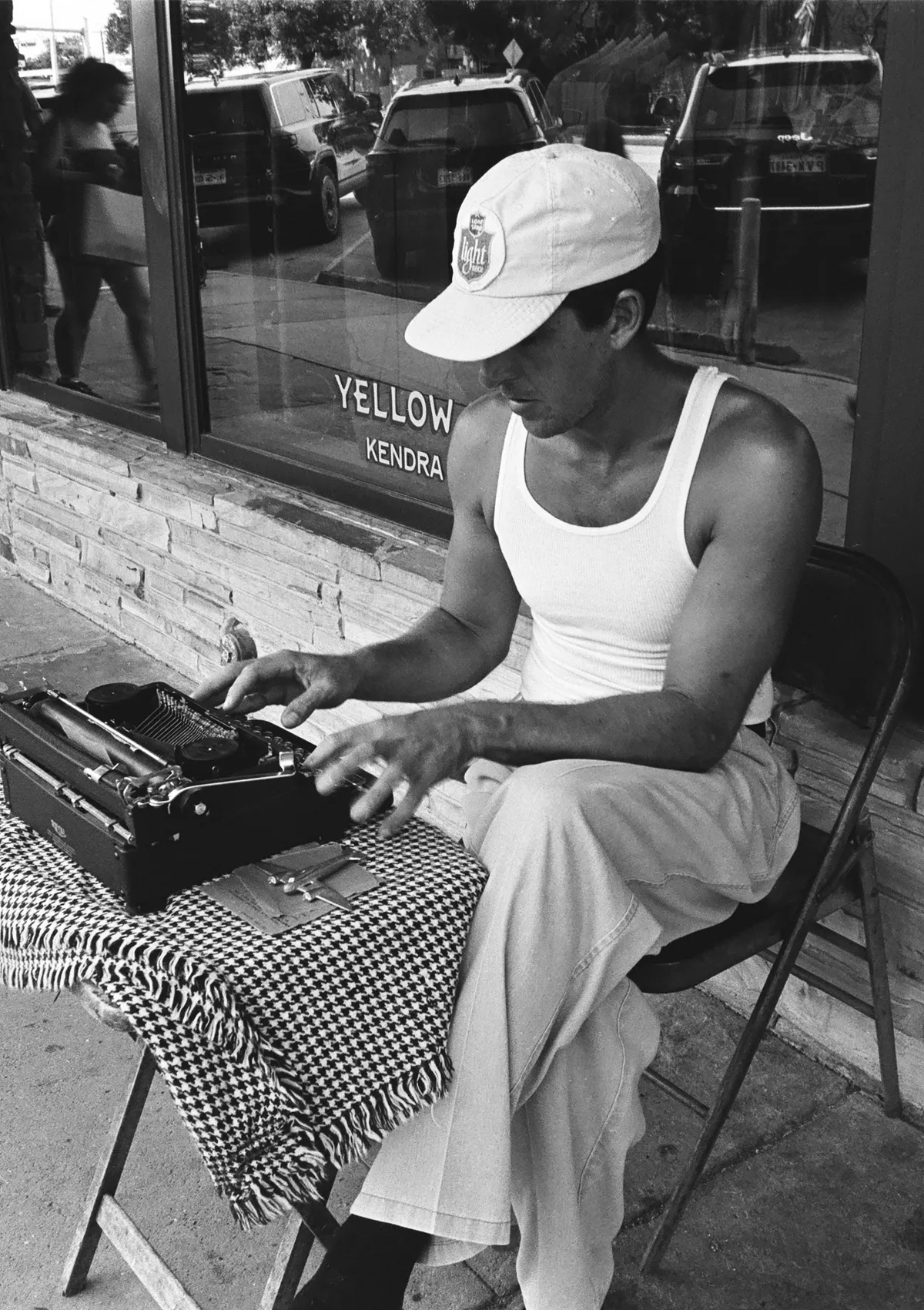
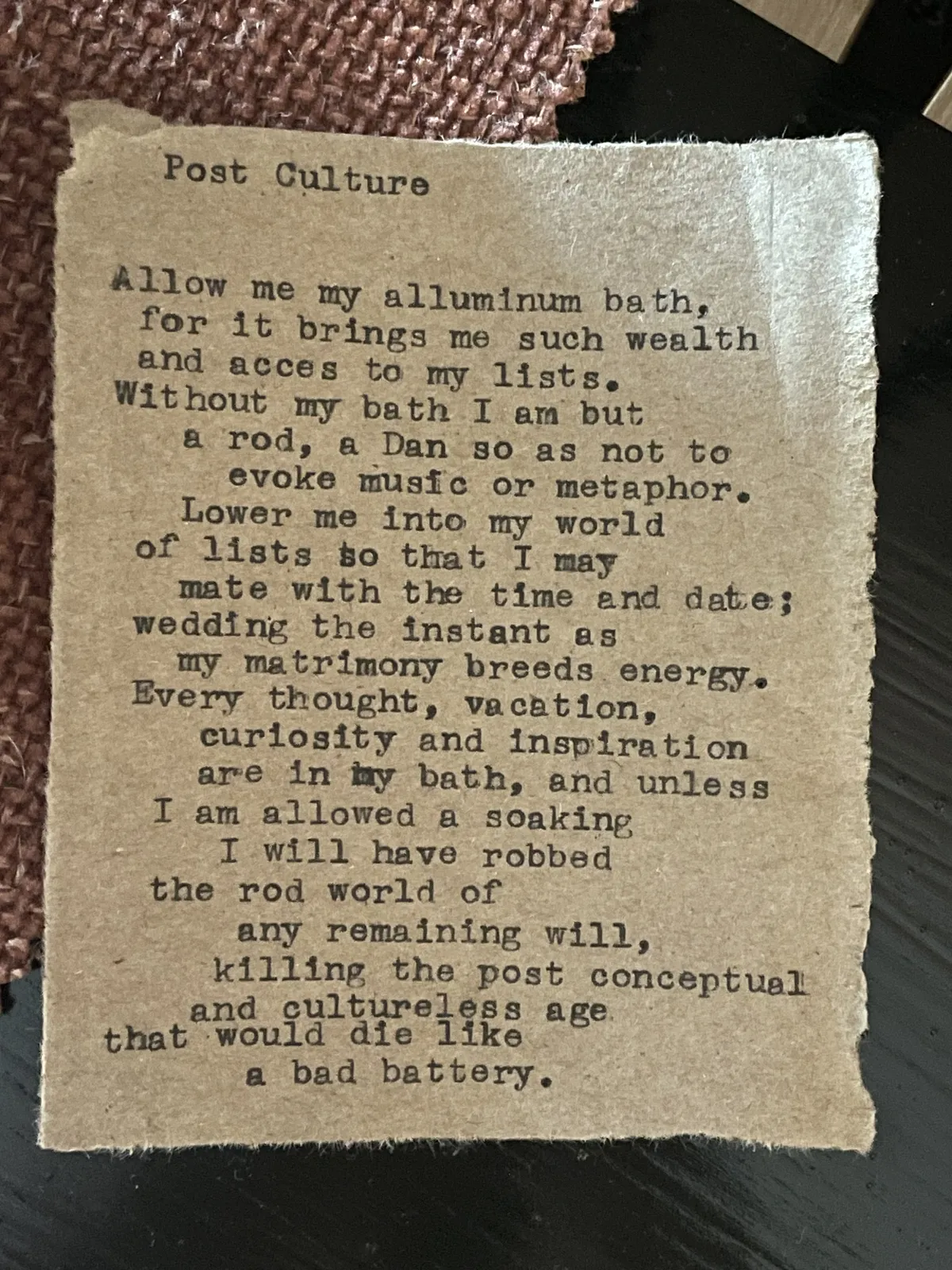
We were not disappointed.
Fugue State
The most distinctive feature of this era, I think, is how much we've lost touch with the remarkable novelty of the ephemeral, natural world.
Sometimes, it feels like a dream. Sometimes, it feels like a waiting room—a place you pass through briefly on your way to your ultimate destination. Fleetingly, it seems present only to the rare souls who pause and pull it into focus.
As such, the world is not enjoyed naturally; rather, it's transformed mechanistically—through intermediaries, brokers, conciliators—and consumed on the terms of others.
How the Internet Changed Us
We didn't really know what the internet was going to be. It started as a well-distributed constellation of independent sites, which naturally mimicked reality. Like physical locations with mailing addresses, new sites got IP addresses (and later, domain names). Naturally, early adopters patronized the sites which interested them most.
Surfing the internet was an exercise in exploration. A constellation of new digital cities—each with different districts, distinct neighborhoods, and unique vibes—you didn't know what you were going to find! And just like a city’s culture that rests at the intersection of its geography, history, and people—internet culture was unique.
Today, however, the majority of the traffic on the internet is aggregated into a few large players: Apple, Microsoft, Amazon, Meta (Facebook), and Alphabet (Google). These companies hyperscalers don't just host our digital lives—they architect them, each platform operating as a walled garden with its own rules, aesthetics, and social norms. Apple's clean minimalism, Google's information omniscience, Meta's algorithmic engagement loops—these aren't neutral containers for culture; they are the culture. In a single day, most people will have only visited two or three of these digital fiefdoms, each interaction subtly molding behavior to fit the platform.
We're not just using these sites; we're being trained by them. Our tastes and habits? Homogenized by the same algorithms, the same scroll mechanics, the same dopamine-optimized notification systems.
Despite these sites doing their best to introduce variety and novelty through groups, audience filters, and algorithm tweaks—what emerges isn't a diverse cultural landscape but a monoculture. Billions of people experiencing slight variations of the same carefully curated reality. Us users? Victims of the policies of the platform. Through relentless optimization of attention-capture, we are slowly being severed from the real world.
We made the internet in our own image; but then, what it became remade us. We are only beginning to understand that.
Homogenization
Today, the trend is uniformity. Consolidation, optimization, and algorithmic thinking are the hallmarks of any modern business. Whether it’s chain restaurants, farming, radio, news, or entertainment—the goals remain eerily similar. This, I believe, is how culture narrows.
It feels like there’s a lot less randomness in the world these days. Random has always come from the physical, natural world—something hard to replicate with software1. We’re drawn to random. To unique. To novel. It stimulates us, teaches us, expands the scope of our experience. Probably, it’s what allows us to develop interest.
There's a healthy balance of random experiences in the real world. Things can be mundane, occasionally terrible, and sometimes—fantastic. But most importantly, it’s representative of reality because it is reality—something everyone experiences together. It's the dietary equivalent of eating whole foods: not too sweet, and comes with a bunch of fiber (i.e., healthy). In contrast, our online worlds would be better represented by a doughnut: all sweet and virtually no fiber (i.e., unhealthy).
Whole Foods vs. Doughnuts
For illustration purposes, let’s call the real world the whole-foods world, and the digital world the doughnut world.
In the real whole-foods world:
- We're surrounded by virtuous, instantaneous feedback loops.
- What we share with others roughly matches what we are seeing and experiencing2 (and vice versa).
- We can make real-time judgments about what's good/bad for us, as we have full context of what we’re experiencing.
In the digital doughnut world:
- We're surrounded by slow feedback loops. Reactions by our friends and family are slow, trickling in over hours (or even days).
- Hungry for more interaction, we tailor what we share to the medium based on the feedback we receive.
- The feedback we receive depends in large part on the algorithm of the hour.
- Over time, we learn what limited categories of content elicit the best response.
- What we share online becomes increasingly disconnected from what we are experiencing in real life.
- Similarly, what we see and receive from others is the same combination of (i) what others have shared, and (ii) what the algorithm thinks is best.
The digital world optimizes for a narrow kind of engagement focused on attention in the same way unhealthy foods optimize for taste through unhealthy levels of sugar, sodium, fat, and artificial sweeteners. It's a poor facsimile of the real thing.
Certainly, it feels like over the last ~25 years of the internet we lost something. But since it was lost to everyone just the same—did anyone notice?
Lessons From The Pendulum
As Becky Chambers, author of Monk and Robot, said:
“It is difficult for anyone born and raised in human infrastructure to truly internalize the fact that your view of the world is backward. Even if you fully know that you live in a natural world that existed before you and will continue long after, even if you know that the wilderness is the default state of things, and that nature is not something that only happens in carefully curated enclaves between towns...you will still have trouble picturing an untouched world. You will still struggle to understand that human constructs are carved out and overlaid, that these are the places that are the in-between, not the other way around.”
Our struggle is even more profound than Chambers describes: our digital constructs are the in-between. I'd settle for any return to the physical world—constructed or otherwise.
In our bones, I think we know this connection to the physical—and specifically the natural—is good for us. We have a special, biological relationship to it—an inherent magnetism that can't be forgotten, but that, with sufficient effort, can be suppressed. I think we've chosen suppression.
But that's also why I don’t think the current paradigm (of digital gardens, social media, homogenization of culture) can last.
We're already witnessing the seeds of change: MP3 players are back, physical book sales are up3, smartphones are becoming dumb again, and film is back in vogue. In a small, perhaps inconsequential act of rebellion, some folks are finding comfort in these mediums of disconnection. Is this merely a vocal counter-culture, or the beginning of a larger movement? Is this post post culture?
I can say with certainty that, like a pendulum at its apex, whatever this moment is feels fleeting. However naive, I'm hopeful that just as life finds a way, we will too. We have an innate desire to reconnect. Perhaps the traumatic birthing of the internet required culture to morph together for a time, and soon—we'll return to some more normal equilibrium. What's the alternative?
The physical world has something to teach us. There’s something special learned through small, mundane, human interaction of “the everyday”. Each interaction is a lesson in connection, in disconnection, in conflict. The world confronts us, bodily. We have to deal with people. And like reading a book, though not every detail is remembered, something is left behind.
Whatever that is, I think we'll all benefit from a little more—soon.
It's why Cloudflare uses a wall of lava lamps, and why Random.org uses atmospheric noise.↩
And if it's not the exact same, it's at least much more closely related.↩
Physical book sales slumped ~25% from 2009–2013, but picked back up with a peak of 800M+ units in 2021.↩