Context Ownership
Over the past few months, the release of popular consumer/prosumer agents like Muse and Grok Bot has me truly impressed. I've used both, and I'm convinced that this paradigm shift from a simple chat interface → persistent AI agent whose knowledge about you grows will be the default way each of us interfaces with AI in the future.
But what's really the difference? The magic of AI agents is due to smart context management. At their core - AI agents are nothing more than the simple chat interfaces we're used to. The difference is the harness - or, the scaffolding that allows the agent to persistently retain, categorize, and retrieve information about you over time.
This is different than the basic memory system from the frontier labs like Anthropic and OpenAI, which isn't something new. Rather, a properly crafted agent system leaves you with a feeling of alive-ness through the clever creation of skills, smart management of routines, and a memory of every message1.
Context As Differentiation
The extent to which companies are able to make this context management a seamless user experience will ultimately be their differentiation - and companies will become increasingly sophisticated at it.
Models will be designed and optimized for certain kinds of harnesses, and for generation and retrieval of the kind of context that is most beneficial in convincing the user of a bot with an ever-increasing persistent memory.
Lock-In
Over time, this will create a new kind of lock-in with these tools. A bot who has learned who it is and who you are will be very hard to walk away from! It'll be analogous to a team hiring and training a new employee after losing one with years of experience.
Interestingly, this presents a new front in the war for data portability requirements. Between the CCPA, GDPR, and EU Digital Markets Act, there's a strong regulatory framework most large companies adhere to which makes getting your data off a platform possible. But with a bot, what counts as your data? For example:
- A credit card statement that I upload to my bot, that's mine ✅
- The statement metadata that is uploaded to my bot, probably also mine ✅
- The routines, context, and "personality" that develop over weeks and months of use of my bot ❓
We can take the above thought experiment to increasing levels of abstraction, and arrive upon at least a few kinds of data whose owner is unclear. On one hand, you have the bot's memories about you, and on the other side, you have a personality of a bot grown from your habits. Do you, as the creator, own that too?
GDPR Art. 20 treats inferred and derived data as something separate from provided data. Certainly, the data an LLM makes about itself can't be considered "provided", right?
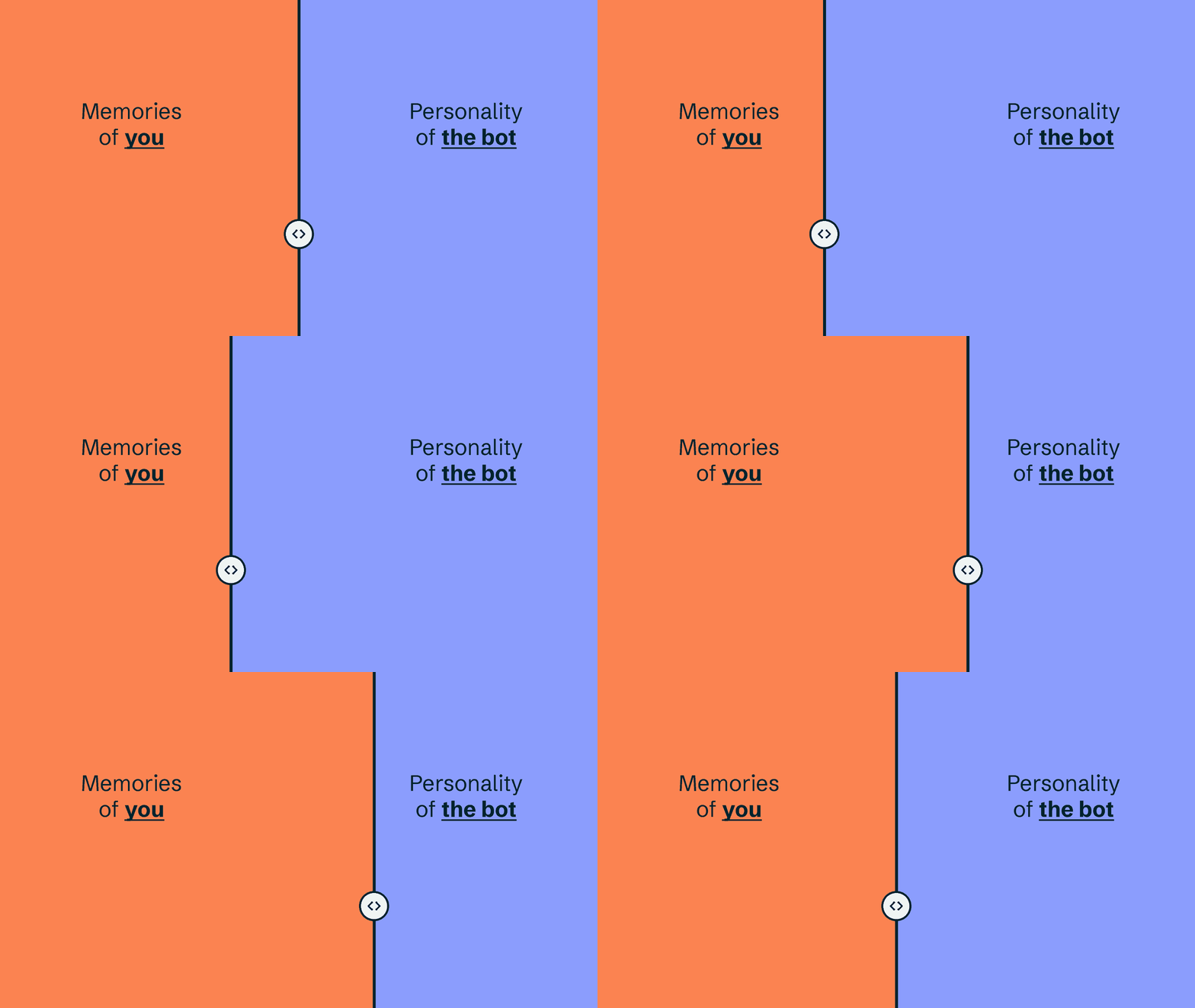
My guess is companies will work to keep context locked in because context will be the magic sauce of differentiation - what is yours vs what is the bot's will be a point of debate.
Lessons in Context
What's interesting about all this is that AI agent systems today, by their very nature, are more flexible in their design than the tools and platforms that have come before. On platforms like Facebook, Instagram, or Google Photos, you can't negotiate the structure of how your data is stored. That is a decision by the platform.
In contrast, due to the nature of LLMs, you do seem able to negotiate the structure and storage of your data. An agent like Muse may want to keep track of your goals, tasks, and schedule in its own app, but with a bit of extra effort you can have it output to your calendar, your to-do app, or your goal tracker. That action, of forcing your agent to structure what it knows about you in a format you decide - that's active context management.
By accident, I realized that's what Nexus became, and I think over time sophisticated users will direct agents to store data in a way that's functional for them, outside of the default agent system.
Which, I wonder if that's the lesson here? Generally, the more context you provide an LLM, the better its responses. Right now, there's a subtle default. When you don't intentionally manage context, it becomes managed for you, and in a way that may be less accessible in the future.
To be clear, it doesn't remember every message. The magic of a good harness is making the user think it does.↩